
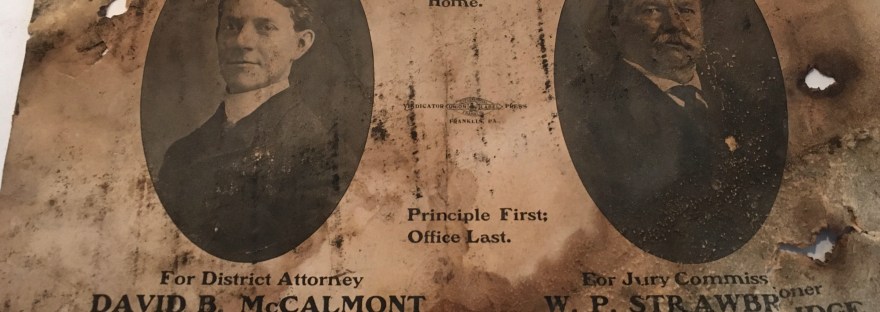
Something I dearly love about public history is the variety of work available. One minute I’m plumbing the depths of online census records, going blind over 19th-century penmanship and wondering why names like Domer and Achsah haven’t made a come-back yet. And the next, I’m cleaning a century’s worth of barn dirt off of a Prohibition Party political poster, hoping what looks suspiciously like desiccated cow manure is, in fact, not. Being a consulting curator is never boring, my friends.
The poster in question came to me in what would professionally be termed “poor” condition. It was discovered during major repair work to the foundation of a barn in Cherrytree Township, Venango County. Originally built around 1900, the barn still functions in its original capacity. Hidden behind a basement wall, the poster champions David McCalmont and W.P. Strawbridge for the 1903 Prohibition Party ticket’s Franklin district attorney and Cherrytree Township jury commissioner, respectively.
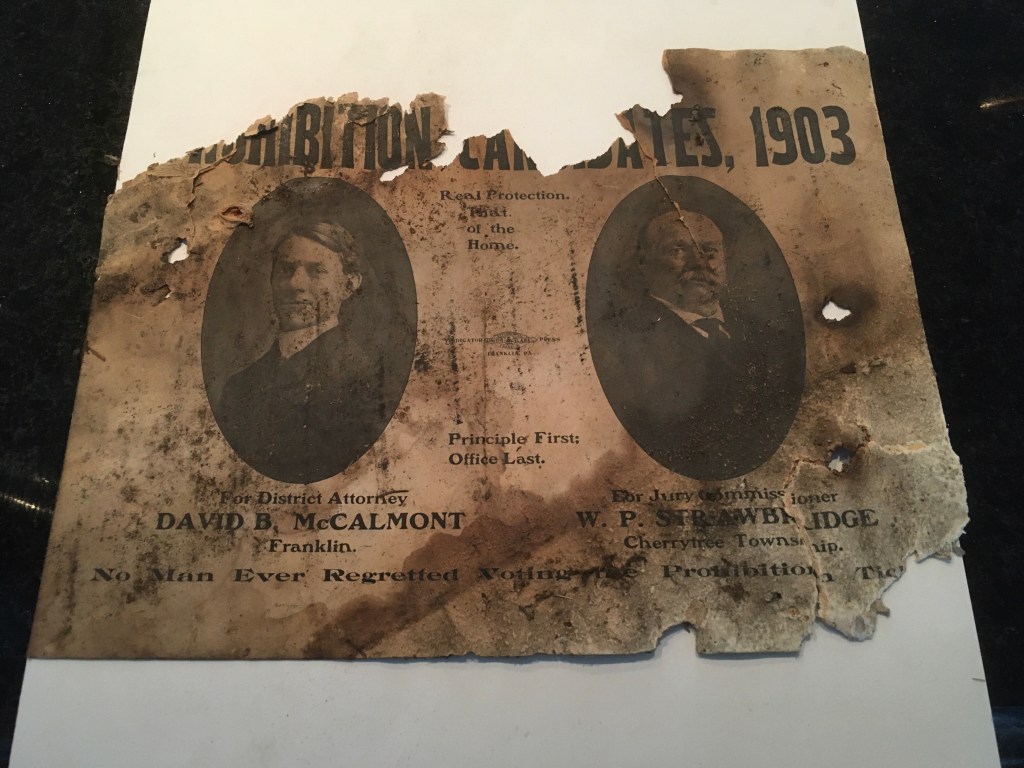
Some issues I could immediately resolve. First, the poster was cleaned with archival-quality paper care products, then stored in an archival folder to prevent further wear and tear. Next, a perusal through local newspapers shone some light on the men campaigning. Articles from the Titusville Herald and the Franklin News Herald from the early 1900s give a glimpse into the growing temperance movement in Western Pennsylvania and across the nation, with rallies, banquets, lectures, and picnics held to encourage support. Venango County’s votes were so close between the Republican and Prohibition candidates in 1903 that winners could not immediately be announced. While ultimately unsuccessful at claiming political dominance with the temperance platform, McCalmont and Strawbridge went on to establish reputations as dedicated community servants and activists.
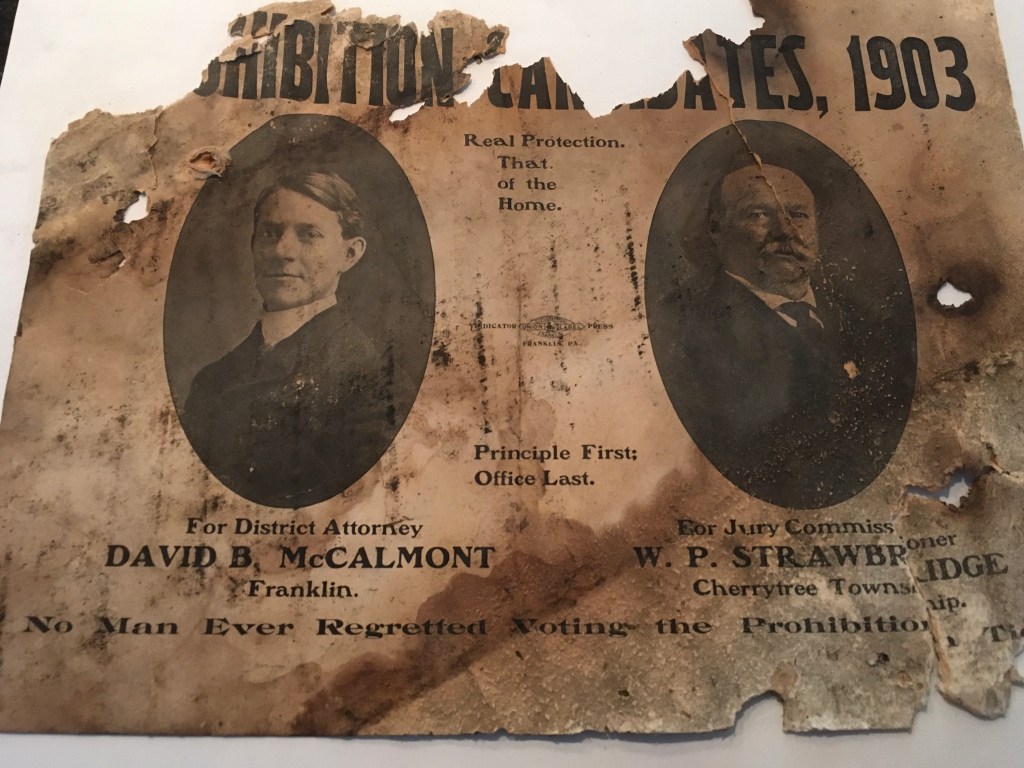
There are other questions, however, whose answers prove more elusive. How did the poster end up in the barn, rather than the farmhouse (a more logical setting for family paperwork, and already a trove of the original family’s photographs and documents)? Did the owners agree with the Prohibition platform, and thus keep the poster in support? Or did they feel ambivalent towards the idea of outlawing alcohol, and simply recycle the paper as farm building insulation? These are things that can’t be sussed out in a Google search. It’s yet another reason why I enjoy my work so much.


 The Free-Range Historian
Fascinating! I was born and raised in Pleasantville. McCalmont and Strawbridge are definitely familiar names to someone of a certain vintage. (wink). Pleasantville, to this day, has no establishments serving alcohol.
In a former New Jersey home of ours, we found, during renovations, an 1896 issue of a Prohibition Party magazine. This was during the “Just Say No” era, so it resonated. We donated it to the local historical society.
LikeLike
Thanks so much for sharing, Christine! That’s a really interesting connection, I wonder how many other regional communities like Pleasantville are “dry” due to work done during that era. A topic worth exploring! –Kelly
LikeLike